Duisburg/Essen, 23rd April 2024
Every year, between 250,000 and 300,000 people in Germany suffer from a stroke or heart attack. These patients suffer immune disturbances and are very frequently susceptible to life-threatening bacterial infections. Until now, little was known about the underlying mechanisms of this immune dysfunction. Research teams from the Faculty of Medicine at the University Hospital of the University of Duisburg-Essen and the Leibniz-Institut für Analytische Wissenschaften – ISAS – e.V in Dortmund have now uncovered a previously unknown cause – and a therapeutic approach. These findings are published in the May 2024 issue of the Journal Nature Cardiovascular Research.
The study was led by Prof. Matthias Gunzer, Director of the Institute of Experimental Immunology and Imaging (IEIB) at the University of Duisburg-Essen (UDE) and Head of the Biospectroscopy Department at the Leibniz-Institut für Analytische Wissenschaften (ISAS), and Dr. Vikramjeet Singh, Head of the Stroke Immunology Unit at the IEIB. They found that in patients one to three days after a stroke or heart attack, the amount of IgA antibodies in the blood decreases drastically – these are essential for defense against infections. Antibodies come in several subtypes, collectively known as immunoglobulins (Ig), which are produced by specialized plasma cells.
To track down the mechanism behind the loss of antibodies – and to improve the treatment of patients with these findings – the researchers used disease mouse models. Mice also experienced a loss of IgA in their blood and stool after a stroke or heart attack. The researchers discovered that specialized DNA fibers released in blood are a factor in the loss of immune defense. These DNA fibers, known as neutrophil extracellular traps (NETs), originate from the nuclei of another type of immune cell, neutrophils. NETs are released into the blood in large quantities by highly activated neutrophils after a stroke or heart attack and can directly kill plasma cells in the intestine. Probably an even more important effect of NETs is the formation of hundreds of small clots in the blood vessels that supply energy to plasma cells in the intestine. This results in a lack of nutrient and oxygen supply and the Ig-forming cells die off in large numbers.
The immunologists and their teams not only succeeded in proving a causal link between stroke, heart attack and immunodeficiency, but they were also able to demonstrate a new treatment approach: If the NETs were destroyed with the enzyme DNase or their release was prevented by a substance with a novel mode of action, the immune defense remained intact. The researchers were able to demonstrate this both in the mouse model and – in the case of DNase – in later clinical studies. "Until now, no therapeutic approaches could be developed because the cause of the immune deficiency was unclear. A treatment that breaks down the NETs or even prevents them from forming in the first place could be a promising new approach to maintaining the immune defense in patients after a stroke or heart attack. It may be possible to prevent serious secondary infectious diseases or even death," says Gunzer.
Article in Nature Cardiovascular Research
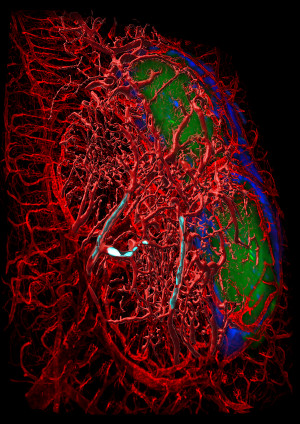
Fluorescence ultramicroscopy image of the special intestinal tissue of a mouse, which contains a particularly large number of Ig-producing plasma cells: Blood vessels are shown in red, immune cells appear green (B cells) or blue (T cells). An ischaemic stroke triggered the formation of vascular thrombi (grey). As a result of the subsequent lack of blood flow, the immune cells die.
© UDE/Laura Karsch und Ali Ata Tuz