Dortmund, 28th September 2026
More than 900,000 people worldwide die of colorectal cancer every year. Metastases are responsible for the majority of cancer-related deaths. The mechanisms that enable individual tumour cells to form metastases are still poorly understood. An international team of researchers, including scientists from MIT, Harvard Medical School, the Faculty of Medicine at the University of Duisburg-Essen and the Leibniz-Institut für Analytische Wissenschaften (ISAS), has now identified a metabolic mechanism in a preclinical model that drives metastasis in colorectal cancer: the body’s own synthesis of ceramides. The fat content of the diet influences this process. The researchers have now published their findings in Science.
“Why do some tumour cells develop the ability to spread throughout the body, whilst others remain in the primary tumour? These processes, including in the case of colorectal cancer, have so far remained largely unclear. We have therefore investigated this question at the level of cellular metabolism. In doing so, we have discovered a molecular mechanism that plays an important role in the development of metastases,” says Prof. Dr Dr Alpaslan Tasdogan, from the Department of Dermatology at Essen University Hospital and head of the Preclinical Metabolomics Research Group at ISAS. The oncologist is one of the corresponding authors of the publication.
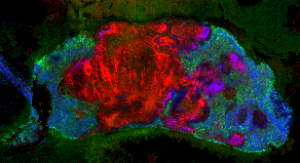
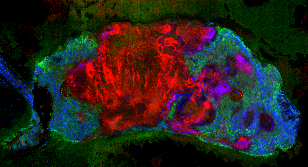
Ceramides in colorectal tissue: The cross-section shows the spatial distribution of various lipids in colorectal tissue, visualised using Mass Spectrometry Imaging (MSI). Ceramides are shown in green. They are components of cell membranes and also act as bioactive molecules. In this case study, ceramides are found primarily in the area of the tumour cells. The other colours show the distribution of other lipid classes within the tissue.
© ISAS
Using various investigative methods, including transcriptomics and extensive lipidomics analyses, the scientists investigated how the metabolism of colorectal tumour cells change. They found that there were significant differences between mice on a standard (control) diet and those on a high-fat diet: 249 lipid species were significantly elevated in the high-fat diet group. Ceramides were the most enriched lipid class. Ceramides are components of cell membranes and also act as bioactive signalling molecules. A localised analysis of the lipids in the gut revealed: “The elevated ceramide levels are particularly associated with tumour cells. Ceramide levels rose further in mice on a high-fat diet compared with those on a standard diet,” explains Prof. Dr Sven Heiles, head of the Lipidomics research group at ISAS.
Even a high-fat diet of limited duration causes permanent changes in tumour cells
The researchers also investigated whether diet-induced changes in tumour cells are permanent. To do this, they generated primary colorectal cancer organoids (three-dimensional cell cultures derived from colorectal tumour tissue) from mice that had been fed either a control diet or a high-fat diet. They then transplanted the organoids into mice that had previously been fed a control diet. Whilst there was no difference in the mass of the primary tumours or in the survival of the animals, the organoids derived from the tumours of the mice fed a high-fat diet formed significantly more liver metastases. “The pro-metastatic properties triggered by the high-fat diet are therefore retained in the tumour cells, even if the high-fat diet is not continued,” concludes Tasdogan.
Ceramides activate YAP and promote cellular plasticity
The researchers found evidence of the molecular mechanism: ceramides activate YAP (Yes-associated protein) by increasing the activity of the enzyme PP2A, thereby facilitating the removal of phosphate groups from YAP. Through this activation, YAP induces a regenerative state in the tumour cells. This increases their cellular plasticity – that is, their ability to adapt their properties to new conditions. This promotes the formation of metastases.
Potential therapeutic approach identified
In their study, the researchers were able to interrupt the metastasis cascade by inhibiting ceramide synthesis. Ceramide metabolism could therefore represent a potential therapeutic target in metastatic colorectal cancer. Further investigations are planned to clarify, amongst other things, the influence of other lipids on the cellular plasticity of tumour cells and the YAP signalling pathway.
Original publication
Ceramide synthesis mediates colorectal cancer metastasis through a YAP-driven regenerative programme https://www.science.org/doi/10.1126/science.adw8520
Downloads
-
PDF (0.14MB)
Press release: Ceramides Drive Metastasis in Colorectal Cancer
-
PNG (0.1MB)
Ceramides in colorectal tissue
(The photo is available for editorial use exclusively exclusively for reporting on this subject. Credit: ISAS)
-
JPG (0.14MB)
Portrait of Jun.-Prof. Dr. Sven Heiles
(The photo is available for editorial use exclusively for reporting on this subject. Credit: ISAS / Hannes Woidich)
-
JPG (0.09MB)
Portrait of Prof. Dr. Dr. Alpaslan Tasdogan
(The photo is available for editorial use exclusively for reporting on this subject. Credit: ISAS / Hannes Woidich)