Skip to content

What’s Your Task as an Intern, Christopher?

Dortmund, 29th October 2021
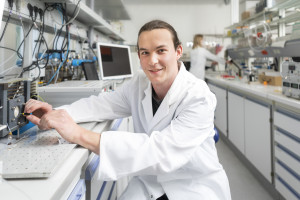
Christopher Borg in the laboratory.
© ISAS

Christopher Borg liked his internship so much that he continued to work at ISAS as a student assistant.

Christopher Borg (24) studies Environmental Monitoring and Forensic Chemistry at the Hamm-Lippstadt University of Applied Sciences. During his internship at ISAS, he worked in the Miniaturisation group and investigated the influence of the inside diameter of an ionisation chamber developed for the Flexible Microtube Plasma (FµTP) on ion mobility spectrometry.

  • At ISAS I am working on…

    using a miniaturised plasma as an ion source for ion mobility spectrometry.

  • It has happened to me in the laboratory that…

    I wasn't careful enough and accidentally knocked a few things over. After that, I was really awake.

  • My highlight every day is…

    the cup of coffee in the morning, which is also the only constant – because every day, there are new things awaiting me in the lab.
Share

Further articles

3 Questions for Lukas Fu

How can AI support the analysis of biomedical images? This was the question Lukas Fu explored during his school internship at ISAS. The 15-year-old also successfully completed his first programming project.

Lukas Fu, a 15-year-old with short black hair. He is wearing glasses and is sitting on a low wall.

Separating Fluorescence Signals Faster and More Precisely with AI

When different fluorescence signals overlap during microscopy, their clear assignment to specific biological structures becomes difficult. To address this common problem, Dr Davide Panzeri is developing AI-based signal separation methods. The biophysicist has been awarded a Marie Skłodowska-Curie Fellowship by the European Union for his promising research project.

Porträt Dr. Davide Panzeri.

Passionate Research, Shaping the Future

How do GRK5 inhibitors work at the cellular level and within the living organism? Biologist Dr Susanne Grund is working with her colleagues at HI-FIVE on a new therapeutic approach for heart failure. In this portrait, she describes what her day-to-day work looks like, balancing research on human stem cells with studies on mice.

ISAS BFF Uploader

What are you doing at ISAS, Theresa?

Why do mice undergo ultrasound examinations of their hearts? What does a typical working day in the lab involve for a technical assistant in the HI-FIVE research project ? And what challenges does the job present? Theresa Pietz provides fascinating insights into her duties, motivations and experiences working with animals.

Study with Heart: A Doctor Bridging Clinic & Laboratory

What is actually happening behind the scenes of a patient trial? Anna Ruzhyna is a clinical research associate who looks after participants with heart failure as part of the HI-FIVE project. She explains how her work helps to develop new therapeutic approaches for the treatment of heart failure.

Laboratory Meets Clinic: Understanding Heart Function with Stem Cells

How can new therapeutic approaches for heart failure be developed more effectively? Stem cell research plays a central role in the HI-FIVE project. In this interview, PD Dr Anna Klinke (Herz- und Diabeteszentrum NRW) talks about her work between the lab and the clinic. She explains how the versatility of stem cells enables heart and vascular cells to be obtained from individual patients' blood and why this is an important step in investigating the specific effects of new active substances.

What are you doing at ISAS, Kevin?

What changes take place in heart muscle cells when a left ventricular assist device is used? ISAS doctoral student Kevin Hau (28) is tackling this question by researching the consequences of heart attacks using various omics analyses.

Kevin Hau is wearing a white coat bearing the ISAS logo. He is standing next to a microscope in a laboratory. In the lower left corner of the image, a computer screen can be seen. Open on the monitor is a microscopic image of reddish tissue.

Copenhagen: Different Molecules, New Perspectives?

Felix Hormann is spending three months conducting research at the University of Copenhagen. In this interview, the ISAS doctoral student discusses the new perspective he has gained on his lipid research and his exciting day-to-day life as a scientist in Denmark.

Felix Hormann is standing at a crossroads. In the background, there is a traffic sign with writing in Danish.