Dortmund, 31st July 2026
For many people with heart failure, the diagnosis not only severely restricts their daily lives. According to the Deutscher Herzbericht 2024, this life-threatening condition is also the sixth leading cause of death. For around half of patients, treatment with currently available drugs is not an option, or these drugs are simply not effective enough. This is where the HI-FIVE research project (see info box) comes in. Scientists and clinicians are working on a new drug-based therapeutic approach designed to close the existing gap in care for those affected. To this end, their research encompasses cell cultures, human stem cells, experiments with mice and a clinical trial involving patients.
Not all cases of heart failure are the same. In women, impaired relaxation of the heart muscle is more commonly the cause of reduced filling of the left ventricle, whereas in men, the most common cause of heart failure is reduced cardiac output. These different manifestations of the condition make it difficult to provide appropriate treatment with currently available drugs. In the HI-FIVE project, researchers are further optimising GRK5 inhibitors – active substances that inhibit the key enzyme GRK5 which is up-regulated in heart failure – to pave the way for a new, targeted drug therapy. In doing so, they consider sex- and age-specific aspects of heart failure.
„Animal testing is only permitted if it is indispensable.“
The initial focus is on the effect of GRK5 inhibitors on human cardiomyocytes (heart muscle cells) and endothelial cells (cells lining the walls of blood vessels). The researchers isolate pluripotent stem cells from blood samples taken from patients and healthy individuals, which can be developed into various cell types in the laboratory. They then use these to produce the specialised cells required for their research. This allows potential positive and negative effects to be identified at the cell culture stage, before deciding whether the active substances need to be tested in living organisms in the next step.
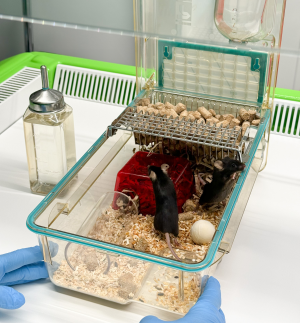
In addition to water, food, and bedding, mice in animal facilities are provided with play materials (known as ‘environmental enrichment’) to support species-appropriate housing: The red shelter and nesting material allow the animals to shape their environment and create a place to retreat. The wooden ball and the transparent tube provide important opportunities for stimulation and activity. The latter also enables positive ‘handling’ interactions between the animals and animal care staff, for example when the mice are picked up and held.
© ISAS
Wherever possible, researchers at HI-FIVE opt for animal-free alternatives rather than conducting experiments on mice. For certain research questions, however, so-called mouse models are necessary because no viable alternative methods currently exist. For example, complex mechanisms of action within a living organism cannot be studied in a Petri dish. “Under the Animal Welfare Act, animal testing is only permitted if it is indispensable – that is, if there are no alternative methods available for gaining knowledge”, explains Prof. Dr Gero Hilken, Animal Welfare Officer at ISAS and Head of the Central Animal Laboratory at University Hospital Essen.

Prof. Dr Gero Hilken, Animal Welfare Officer at ISAS and Head of Central Animal Laboratory at University Hospital Essen.
© UK Essen
Researchers at HI-FIVE plan all animal experiments in consultation with the animal welfare officer. Before the State Office for Consumer Protection and Food Safety of North Rhine-Westphalia (Landesamt für Verbraucherschutz und Ernährung NRW, LAVE) can approve an animal study, researchers must provide a detailed justification demonstrating that the study is indispensable, and that no alternative method can answer the research question. “Experiments cannot be approved if the distress caused to the mice is disproportionate to the knowledge gained”, says Hilken. The 3R principle – replace, reduce, refine – applies to every experiment in the EU.
Research for the benefit of people – with responsibility towards mice

Prof. Dr Kristina Lorenz, Head of the department Translational Research at ISAS.
© ISAS
In order to assess the effects of treatment with GRK5 inhibitors in women and men with heart failure, the researchers are also studying male and female mice of various ages with different forms of the condition. “We conduct research for the benefit of people and are fully aware of the profound responsibility that comes with conducting experiments on mice,” emphasises Prof. Dr Kristina Lorenz, pharmacologist and Head of the Translational Research department at ISAS. She coordinates the HI-FIVE project. Only researchers on her team who have completed intensive training and are qualified to perform specific procedures are permitted to conduct experiments with mice. “Approximately four million people in Germany suffer from heart failure. For this serious condition, our research is making an important contribution to the development of urgently needed new therapeutic options,” says Lorenz.
For their analyses, the scientists induce various characteristics of heart failure in the mice, such as increased cardiac workload or metabolic changes, to assess typical disease progression and different manifestations. Echocardiography, pressure and volume measurements, ECG analyses and tissue examinations help to investigate the effect of GRK5 inhibitors on heart function, heart growth and the risk of cardiac arrhythmias.
Another component of the research project: a study with patients
Additionally, a clinical study involving patients is being conducted to analyse data on cardiac function, exercise capacity, and comorbidities such as chronic kidney disease. By combining these data with findings from experiments with human stem cells and mouse studies, researchers and clinicians gain a more comprehensive understanding. This enables them to identify which GRK5 inhibitors show the greatest promise as preclinical drug candidates for the development of new therapeutic approaches.
HI-FIVE
In the HI-FIVE research project, scientists and clinicians from ISAS, Lead Discovery Center GmbH and Herz- und Diabeteszentrum NRW are collaborating on a new therapeutic approach for the treatment of heart failure. The focus is on GRK5 inhibitors which specifically block a key enzyme that becomes overactive in heart failure. The aim of the project is to develop new options for more precise treatment of heart failure, particularly in cases where existing drugs are not sufficiently effective. The collaborative project began in 2025. It will run for three years and is funded with around 2.1 million euros by the European Union and the State of North Rhine-Westphalia.
(Eske Haverkamp / Sara Rebein)
As member of the Leibniz-Association, ISAS supports the »Initiative Transparente Tierversuche« and »Tierversuche verstehen – Eine Informationsinitiative der Wissenschaft«.