Dortmund, 2nd July 2026
For their paper in Advanced Science on stable subtypes of neutrophil granulocytes, researchers from ISAS and the Faculty of Medicine at the University of Duisburg-Essen have brought together their expertise from various disciplines. From the initial idea of not being misled by the external appearance of these immune cells right through to the analytical methods used to decipher their molecular signatures and functional differences: four of the authors provide insights into their scientific contribution and the interdisciplinary collaboration behind the study.
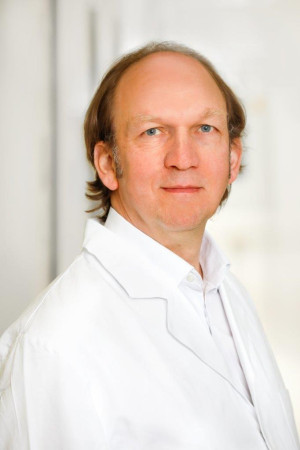
Prof. Dr Matthias Gunzer is Director of the Institute for Experimental Immunology and Imaging at Essen University Hospital. He is also Head of the Biospectroscopy Department and Biofluorescence research group at ISAS.
© ISAS / Hannes Woidich
Professor Gunzer, why did you come up with the idea to take a closer look at these neutrophil subtypes?
“I was puzzled to see CD177+- and CD177-- neutrophils in humans and at the same time reading in reviews, that CD177- would just be transient states that become CD177+ upon activation. However, no one had actually put this to test. So we decided to do this and then we saw, that the general assumption was wrong. CD177- cell never produced CD177, even though they were clearly activated. This was the actual moment of discovery. ‘All the rest’ was essentially coming up with good ideas how to clarify this finding further. And with the proteomics and lipidomics analysis, it was the first time that we were able to see a massive difference between both cell types.”
Now that you've shown that CD177-negative neutrophils represent a distinct, stable subgroup, and that CD177-defined neutrophil subgroups have different functions – for example, in head and neck tumours and stroke – what are the next steps in your research?
“Since we had shown in a parallel study that CD177--cells are bad for recovery from stroke, we now have two important diseases, where we know that CD177- cell are problematic. Maybe there are even more. At the same time, I’m also convinced, that there will be situations, where the CD177--cells are beneficial. Otherwise, they would not have been maintained during evolution. Therefore, we’re now actively searching for such conditions. In addition, we’re trying to find out, whether there are special drugs that would allow us to selectively modulate CD177- neutrophils, for example as a treatment in early head and neck cancer.”
Professor Chen, you developed the customised computational data analysis. Could you explain how you approached it and what your software helped reveal?
“Our biologists were curious whether the CD177+- and CD177-- cells looked different in any aspect, just based on the appearance. They had gained the impression of no significant difference by browsing the images and looking at them with their eyes. They could hardly believe what they saw. So, they came to us, since we build ‘eyes and brains’ for computers to understand microscopy images at our AMBIOM group.
We developed a customised image processing and analysis pipeline that read in several hundreds of microscopy images, segmented out each individual cells, and then conducted a comprehensive profiling of the nuclear and cell ‘appearance’ – based on morphology and textures-, and finally performed a statistical analysis to check whether the CD177+- and CD177--cells had a difference of any aspect in their appearance. At the end, we were able to confidently confirm that there is indeed no significant difference.”

Prof. Dr Jianxu Chen is Head of the ISAS junior research group AMBIOM – Analysis of Microscopic BIOMedical Images.
© ISAS / Hannes Woidich
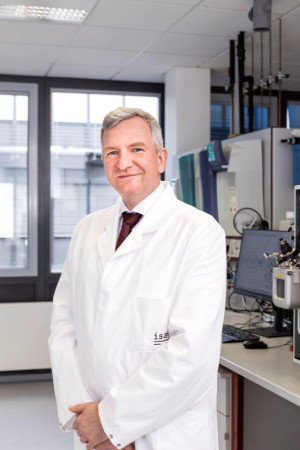
Prof. Dr Albert Sickmann is ISAS CEO and Head of the Bioanalytics department and Proteomics research group.
© ISAS / Hannes Woidich
Professor Sickmann, what insights did the mass spectrometry analysis of the neutrophil proteome reveal?
“The mass spectrometry analysis revealed unexpected differences between two types of neutrophils, CD177⁺ and CD177⁻. Although these cells looked very similar under the microscope and behaved similarly in standard laboratory tests, their protein composition was surprisingly different. In particular, CD177⁻-neutrophils contained higher levels of proteins that are often linked to tumor‑promoting immune responses, while CD177⁺-neutrophils showed proteins related to immune activation. These findings suggest that the two neutrophil subtypes may have different roles in the immune system, even though they appear almost identical at first glance. In the future, such molecular differences could also serve as potential biomarkers for neutrophil function.”
Doctor Alshaar, why did you examine the neutrophil lipidome, and what role do lipids play in neutrophil function?
“The regulation of lipids in other immune cells such as macrophages has been reported. In the reported cases the lipid alterations are associated with function consequences for the immune cells such as improved/decreased activity of the immune cells. As very little is known for neutrophils we decided to look if we can observe lipidomic changes in CD177+/- cells which are in line with the phenotype, meaning the observable functional characteristics of each neutrophil subtype.”
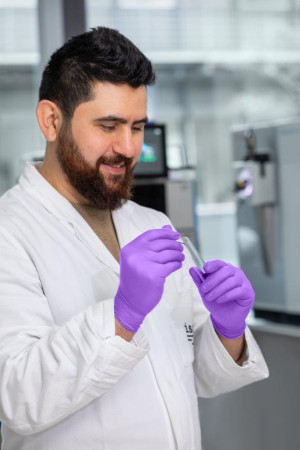
Dr Belal Alshaar is a Research Associate in the Lipidomics junior research group.
© ISAS / Hannes Woidich
With the integrated proteomics and lipidomics analysis, you all were the first to demonstrate that the molecular signatures of CD177-defined neutrophils differ markedly from one another. Without going into much technical detail: what information did you get from your combined analysis and how?
“With the proteomic and lipidomic data, we were able to show that CD177--cells use less ß-oxidation for energy production and are not able to produce arachidonic acid metabolites to the same extend as CD177+-cells. This means CD177- should be not as active as CD177+ and should not be able to use prostaglandins to the same extent as CD177+-cells. Prostaglandins are known in neutrophils to mediate immune reactions. This molecular behaviour is consistent with the observed cellular phenotype, at least for the studied diseases head and neck tumours and stroke.”