Dortmund, 28th May 2026
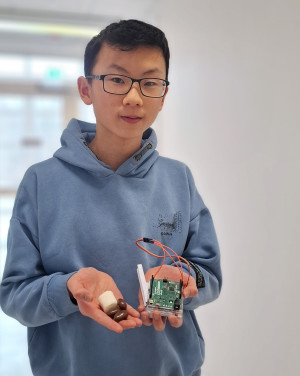
Lukas (15) is in Year 10 at Leibniz Gymnasium (Leibniz grammar school) in Dortmund. Instead of attending school lessons, he undertook an internship at ISAS in the spring of 2026. For two weeks, he shadowed the researchers in the AMBIOM – Analysis of Microscopic BIOMedical Images junior research group. In this interview, Lukas explains what he was able to explore and learn during his time at ISAS.
1. Why did you choose to do your internship at ISAS?
Lukas: I chose this internship because I had already heard of ISAS as a research institute and was curious to find out how research is carried out there. I’m also interested in chemistry and biology.
2. What did you work on during your internship?
Lukas: I was part of Dr Jianxu Chen’s team. During the first few days, I was given the opportunity to get to know the group’s research a little. For example, I watched a tutorial on how cells can be separated from one another – that is, segmented – using AI. During my internship, I also had my own project: I programmed a game using AI.
To do this, I used a website as a platform and the Python 3 programming language. My finished game is called ‘Block Jumper’s Adventure’ and is a kind of platform game. You can choose between three rectangles of different colours as your character. The game has an infinite number of levels, which are generated randomly after the starting level. There is also a day-night cycle throughout the various levels. In addition, a timer runs whilst you play. The aim is to cover as much ground as possible in a short time, overcoming obstacles and enemies whilst collecting coins. You can play the game in your browser on both your mobile phone and computer.
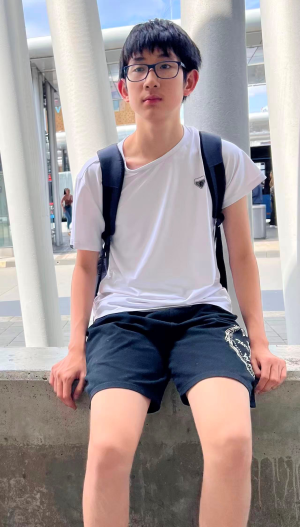
Having already gained some initial programming experience at school, 15-year-old Lukas developed his own game using AI at ISAS.
© privat
It took me about two working days to programme the game; on the third day, I incorporated a few improvements. Finally, I gave a presentation about the project to the whole research group. As is common in science, I explained exactly how I approached the work and then answered questions.
3. What did you take home from your time at ISAS?
Lukas: At school, I’m taking robotics as an optional subject. There, we also work with the Linux operating system and a Raspberry Pi as a small computer. So, I already knew a little bit about programming. At ISAS, I also gained my first experience with Python 3 and learnt how to use a website as a platform. I was also given the opportunity to visit the laboratories of the Bioimaging research group, with which AMBIOM collaborates.
I found it fascinating to see how the researchers at ISAS work and how many different scientific disciplines come together in the process. Research is not only about carrying out experiments in the lab – computers and AI are also very important, for example when analysing data.
Click here to play Lukas's game: https://block-jumper-hazel.vercel.app/
(The interview was conducted by Elai Arts.)